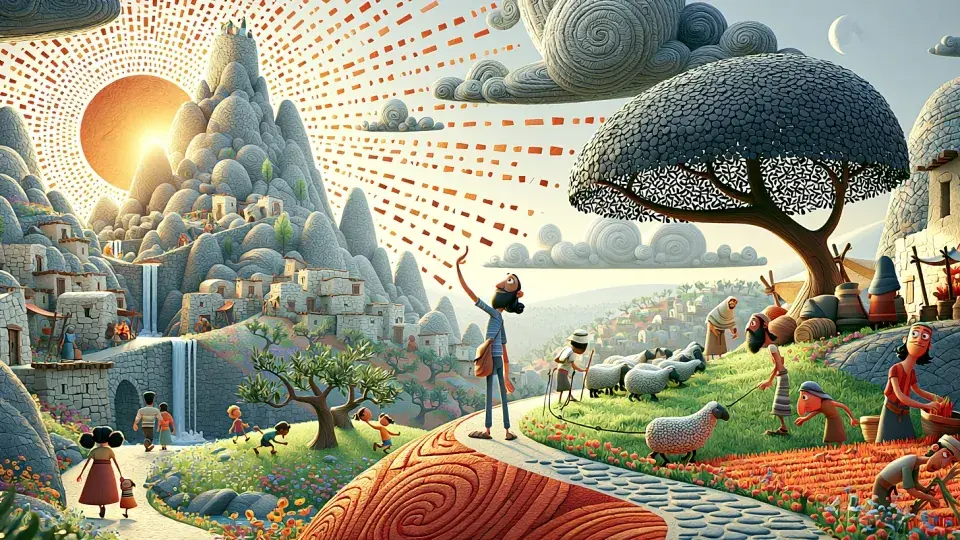
Looking at the mountains, the writer asks: where does help come from? The answer is: from God, who made the mountains, and the whole world! God never falls asleep on the job. He watches over us coming and going, now and forever. He is our shade and our keeper.
- 1I lift my eyes to the mountains— where does my help come from?
- 2My help comes from the LORD, the Maker of heaven and earth.
- 3He will not let your foot slip— He who watches over you will not slumber;
- 4indeed, He who watches over Israel will neither slumber nor sleep.
- 5The LORD watches over you— the LORD is your shade at your right hand;
- 6the sun will not harm you by day, nor the moon by night.
- 7The LORD will keep you from all harm— He will watch over your life;
- 8the LORD will watch over your coming and going both now and forevermore.
What it means
When you feel like you need help, look to God — the One who made heaven and earth. He never sleeps, never gets tired, and is always watching over you. You are never alone.
A little prayer
Lord, my help comes from You! You made the whole universe and You never stop watching over me. Thank You for protecting me day and night. I trust You completely. Amen.
Memory verse
“My help comes from the LORD, the Maker of heaven and earth.”
Psalm 121:2 (BSB)
A travelling song. It is the right verse for the school gate, the first night away from home, and the back seat of a long car journey.
Talk about it
Questions with no single right answer — for a family table or a Sunday-school circle.
- The psalm starts by looking up at the hills. When you need help, where do your eyes go first?
- It says God 'will neither slumber nor sleep'. Why is it a comfort that somebody is awake while you are not?
- This was a song for people walking a long way to Jerusalem. What do you sing, say or think about on a long journey?
- The last line covers 'your going out and your coming in'. What are the going-out and coming-in moments of your day?
Try this
The going-out and coming-in map
Draw a simple map of your day — bed, breakfast, the front door, school, the way home, bed again. At each stop write one word for how you feel there. Then read verse 8 over the whole map and mark the two doors: going out, coming in.
You will need: A long strip of paper and pens.
More Protection psalms
Scripture source
Berean Standard Bible (BSB)
psalmsforkids.com/psalms/121